Gyanvapi The history and solutions
Gyanvapi Masjid is an another controvert recently in limelight. A section of Hindu devotees has appealed against the Masjid on the ground that it was a magnificent Shiv temple previously which was captured, destroyed and a mosque was built in its place by one of the Mughal invader Aurangazeb.

In the first place the most painful and mysterious attitude of Mughals are that they always relied on destroying the existing temples to built a mosque instead of building a mosque at an independent controversy free land. It is even amazing to realize that in "Holy Quran" one of the Surah clearly and categorically mentions that "at any circumstances a" Masjid"(Mosque) cannot be rather should not be built at a disputed site...

One of the Muslim brother sharing his opinion about Gyanvapi mandir Mosque issue as well as on 1000s of other disputed sites in India
But, to my dismay it is a reality that 100% of all the major nationally important masjids are built destroying Hindu or Jain temple's... which is against the direction of pristine holy book "Holy Quran".

A Malayalam documentary presented by Kerala's news channel during 1900s... about the history of Kashi temples and the atrocities of Mughals....
The objection towards videography of the masjid premises raises many eye brows as it reflects the timidness of mosque authorities on the ground facts which may be revealed... Otherwise there cannot be any reason for this reluctance.

The problem becomes grave when we commit a wrong, and fail to regret on the same, and we start defending the wrong, and when the wrong is under scrutiny, we cry foul and leave all shame besides to defend the wrong for all wrong reasons that too going against the holy books specific direction that "it is wrong to built a masjid at a disputed place".

I humbly appeal to my brothers and sisters from Muslim community to follow every lines mentioned in "Holy Quran", instead of selectively choosing a few lines to one's own selfish benefits at the same time closing the eyes towards the other lines which preaches differently.

Ignoring a few Surah mentioned in "Holy Quran" which if followed and implemented 90% of today's legal issues could be closed voluntarily. But, unfortunately, the adopted trend are sticking towards a few Surahs which was briefed for different situations, but it is wrongly interrupted towards own selfish advantages against the wishes of the "Supreme".

I appeal the members from all religion to succumb to humanity and accept the truth voluntarily and leave adamant attitude so that the Supreme won't feel suffocated due to our acts which might be against its wishes.
Sudesh DJV
India
11th May 2022
6:45 am
Scroll down to find the complete reality about history related to Gyanvapi Mandir and the latest updation after the starting of survey under direction and supervision of Supreme court.

When Aurangzeb's army could not harm the self-styled Jyotirlinga then he attacked the 5 feet high Nandi idol sitting outside the temple. There were many hammers on the idol, many blows were made but Nandi did not move from his place. After all the efforts, the army was defeated and left Nandi in the same place.
This statue is on the side of Gyanvapi Mosque. It is now considered a part of the corridor in the expansion of the temple. This picture is from before independence.
Thus the 353-year-old Gyanvapi Kund became part of the corridor in the expansion of the Kashi Vishwanath temple last year. This picture is of the same Gyanvapi Kund. It was captured on camera around the year 1900. This story is also mentioned in the book 'Sacred City of the Hindus' by K.M.A. Tshering of London.
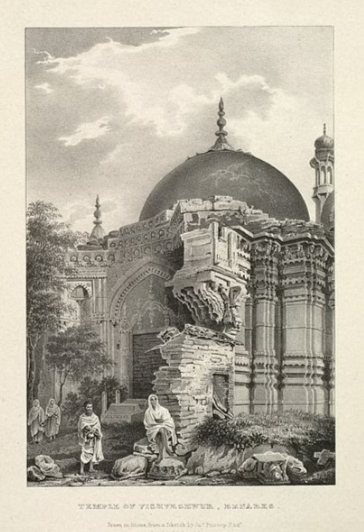
This sketch of Gyanvapi Mosque was made by Anglo-Indian scholar James Prinsep in 1834. The sketch showed the part of the Vishweshwar temple in Banaras that was demolished. In this the big dome of the mosque and the people sitting in the broken part at its outer end are seen. The original wall of this broken part now stands in the Gyanvapi Mosque.
This picture of Kashi Vishwanath temple was taken in 1890. We could not get the information of its photographer. In the picture, the idol of Nandi installed in front of Gyanvapi Kund and the priest sitting in the temple built right next to it can be seen. In the meantime, the British government was getting its northern headquarters constructed in Kashi.
In the picture, a large number of priests have gathered in the Gyanvapi Kund built in the Kashi Vishwanath temple to participate in the daily worship. The huge Nandi idol can be seen in the right side of the picture. A little part of the mosque is also visible when looking upwards just behind the Gyanvapi Kund. The photo is from 1880.
*Religious Worship Act 1991*
कृपया ध्यान से पढे एवं किसी त्रुटी को संसूचित करे
जब से ज्ञानवापी मस्जिद का विवाद शुरू हुआ है तब से Religious Worship Act 1991की खूब चर्चा हो रही है। खास कर इस का जिक्र असद्दुदीन ओवैसी खूब कर रहे हैं। मुझे लगता है इस कानून को लेकर काफी लोग भ्रमित भी हैं। इस कानून के संबंध में काफी कुछ झूठ भी फैलाया जा रहा है।
टीवी न्यूज चैनलों और सोशल मिडिया पर ओवैसी या उनके समर्थक एक बात की दुहाई देते हैं कि Religious Worship Act, 1991 में साफ लिखा है कि अगस्त, 1947 के बाद हर धार्मिक स्थल की यथास्थिति बनी रहेगी। उनमें कोई बदलाव नहीं हो सकता है। उसके खिलाफ कोई याचिका दाखिल या स्वीकार नही होगी।
आप को बता दूँ Religious Worship Act, 1991 कुल चार पन्नों का है, जिनमें आठ क्लाॅज़ेज़ हैं।
इसमें सबसे महत्वपूर्ण है Clause 4(2), ऐसा मुझे लगता है! इस Clause पर शायद ओवैसी साहब का ध्यान नहीं जा रहा है, शायद एक चालाक राजनीतिज्ञ की तरह वे मुसलमानों की आँखो में धूल झोंक रहे हैं, उनको बेवकूफ बना रहे हैं, क्योंकि वे खुद एक शातिर वकील रहे हैं।
Religious Worship Act, 1991 यह जरूर कहता है कि अगस्त 1947 के बाद हर धार्मिक स्थल की यथास्थिति बनी रहेगी। उसके ढांचे में कोई बदलाव नहीं होगा लेकिन दूसरी तरफ इस Act का आर्टिकल 4(2) कहता है कि
1) अयोध्या राम मंदिर विवाद इसके दायरे में नही आता है।
2) वे धार्मिक स्थल, धार्मिक इमारतें भी इसके दायरे में नहीं आते हैं जो ऐतिहासिक हैं।
3) वे धार्मिक स्थल भी इसके दायरे में नहीं आते जिनके 1947 से 1991 के दरम्यान मूल ढांचे में बदलाव किया गया हो।
4) ऐसे विवादित धार्मिक स्थल भी इसके दायरे में नहीं आते जिन पर 1991 के पहले से कोई कानूनी याचिका दायर है।
इस के साथ ही एक और सहायक कानून है,1958, जो "ऐतिहासिक " शब्द की व्याख्या करता है। वह कहता है कि वह हर इमारत/स्थान/परिसर जो 100 साल से अधिक पूरानी है, वह ऐतिहासिक है।
अब जरा ध्यान दिजिएगा! 👇
#पहला- ज्ञानवापी मस्जिद पर कुछ महिलाओं ने पूजा के अधिकार के तहद फरवरी, 1990 में ही याचिका दायर कर रखी है।
#दूसरा-ज्ञानवापी मस्जिद और परिसर में 1947 से 1991 के मध्य काफी फेरबदल किया गया है या कह लें कि इस की मूल संरचना से जानबूझकर छेड़छाड़ की गई है।
#तीसरा- ज्ञानवापी मंदिर-मस्जिद इमारत लगभग 350 साल पुरानी है यानि 100 से भी अधिक। मतलब यह कि यह भी ऐतिहासिक इमारतों की व्याख्या के दायरे में आती है।
#चौथा- ज्ञानवापी मस्जिद और कृष्ण जन्म-भूमि विवाद के लिए कई याचिकाएं दायर हो चुकी हैं और माननीय न्यायालय द्वारा स्वीकार भी हो चुकी हैं। अब तक कोई याचिका खारिज नहीं हुई है।
मुझे लगता है यही तीन मुख्य कारण हैं, जिनकी वजह से ज्ञानवापी मस्जिद हो या कृष्ण जन्म-भूमि विवाद ये दोनों स्थल Religious Worship Act, 1991 के दायरे में नहीं आते। इस Act की जटिलताओं से बाहर हैं।
*उपरोक्त जानकारी कृप्या अपने सभी मित्रों तथा सम्बंधियों को forward कीजिए।



.jpg)


Comments